Solana Bot in Action With Four Fast Trades
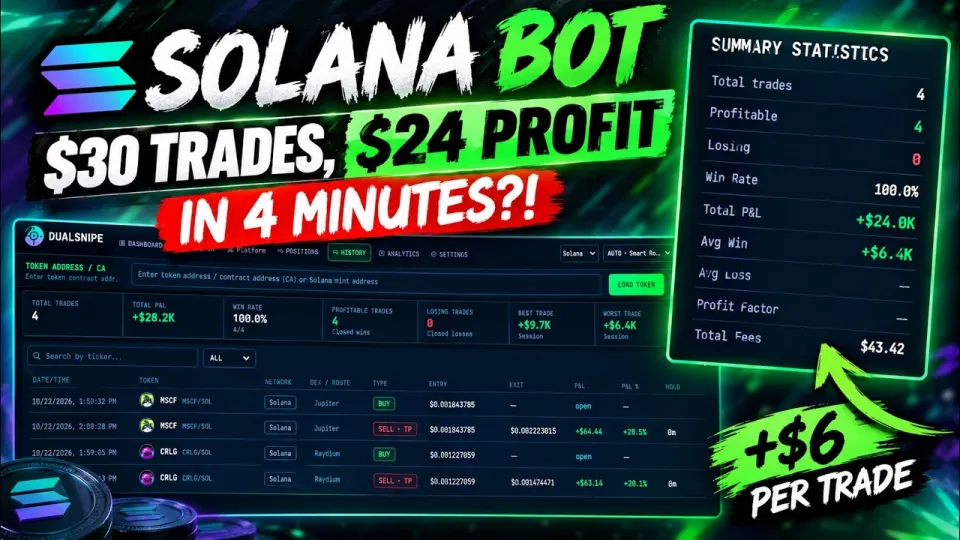
· based on the channel DualSnipe Labs
Key takeaways
- Four trades closed in profit in roughly four minutes in the demonstrated DualSnipe session.
- Average profit was about $6 per trade on positions of around $30, roughly 20% gross per trade.
- The bot executes entries, exits and take-profit orders automatically across multiple Solana DEXs.
- DualSnipe is available as a desktop terminal and as the DualDex web app via Telegram.
- The session is a single example, not a guarantee of future results.
A Solana bot is software that connects to Solana decentralized exchanges through a wallet and executes trades automatically — scanning new tokens, buying on a preset trigger and selling at a take-profit or stop-loss level. In a demonstration published by DualSnipe Labs, the DualSnipe bot closed four trades in profit in roughly four minutes, averaging about $6 per trade on positions of around $30. The product is available through the DualSnipe website, which hosts the bot and download links.
What the four-trade Solana bot session actually shows
The session is a short, automated run on Solana: four positions opened and closed inside about four minutes, each one ending green. On a $30 position, a $6 gain is roughly 20% gross before fees — a number that looks large precisely because the position size is small and the holding time is short. The bot handled the full cycle: entry, monitoring and take-profit execution, with the trade history and P&L visible in the interface.
What such a session does not show is the losing side of the distribution. Four wins in four minutes is a favorable sample, not a base rate. Anyone reading the numbers should treat them as a demonstration of mechanics — speed of execution, order routing, take-profit discipline — rather than an expected return per session.
How an automated Solana trading bot works
The core loop of a Solana trading bot is simple, but every step depends on infrastructure quality:
- Wallet connection. The bot signs transactions with a Solana wallet you control; the private key stays with the wallet, not with the strategy.
- Token discovery. New pairs are detected from on-chain data and DEX feeds, often filtered by liquidity, holder count or age.
- Entry execution. A buy order is built and sent, usually with priority fees to land in the next block.
- Position management. The bot watches price against take-profit and stop-loss thresholds and exits without manual input.
- Routing. The swap is split across liquidity sources to reduce slippage — the description of the DualSnipe session explicitly lists multi-DEX routing across Solana.
A sniper bot is a narrower variant: it targets the first seconds of a token's liquidity and buys before broader attention arrives. That speed is also where the risk concentrates, because the earliest buyers are the ones most exposed to rugs and honeypots.
Multi-DEX routing on Solana: Jupiter, Raydium, Meteora and more
Solana's liquidity is fragmented across venues, and a bot's routing layer decides which one fills each leg of a trade. The relevant names for anyone comparing tools are Jupiter as the aggregator, Raydium and Meteora for pools, Orca for concentrated liquidity, Phoenix, OpenBook and Lifinity for order-book style execution, and Pump.fun and PumpSwap for launch-phase tokens. A bot that routes only through one venue will lose on price whenever a better pool exists elsewhere.
Routing matters most on small positions. On a $30 trade, a few tenths of a percent of slippage plus priority fees can eat a meaningful share of a 20% gross gain, so aggregator coverage and fee settings are not cosmetic details — they decide whether a strategy is profitable after costs.
Solana bot tools compared: DualSnipe, Photon, BullX, Trojan and others
The Solana trading bot market splits into Telegram bots, web terminals and desktop applications. DualSnipe ships as a desktop trading terminal and as the DualDex web app inside Telegram, which covers both patterns. Competing tools frequently named in the same conversation include Photon, BullX, Axiom, GMGN, Trojan, Maestro and Banana Gun, alongside scanners such as DexScreener and Birdeye that are used for research rather than execution.
The practical differences come down to four things: execution latency, routing breadth, the quality of the token scanner and the safety filters, and how clearly the interface reports P&L. A bot that is fast but has no scam filters simply loses money faster, and a bot with good filters but slow execution misses the entries its filters were designed to find.
Typical questions and doubts about Solana trading bots
The questions that come up most around automated Solana trading are about sustainability, capital requirements and safety. A few honest answers:
- Is four wins in four minutes repeatable? No strategy produces only wins. Short sessions on small positions can look spectacular in percentage terms while remaining statistically meaningless.
- How much capital do I need? The demonstrated session used positions of about $30. At that size, fixed costs — priority fees, swap fees, slippage — take a large share of every gain, so results are highly sensitive to fee settings.
- Where do the losses come from? Mostly from tokens that collapse before a take-profit triggers, from failed transactions during congestion, and from slippage on thin liquidity.
- What should I check before running a bot? Whether the wallet is separate from your main holdings, whether stop-losses exist at all, and whether the tool's trade history is verifiable rather than a highlight reel.
Where to get DualSnipe and how to start
All official entry points for the bot are listed below:
- Website and product overview: https://dualsnipe.com/
- Desktop trading terminal download: https://dualsnipe.com/api/download
- DualDex web app via Telegram: https://t.me/dualdexbot
Start with a small position size, keep a dedicated wallet with limited funds, and verify each trade in the history rather than relying on a single session's summary. Automated execution changes speed, not the underlying risk of memecoin trading.
Summary
The DualSnipe Labs breakdown shows a Solana bot closing four profitable trades in about four minutes, with roughly $6 per trade on positions of around $30, executed automatically with multi-DEX routing and take-profit logic. It is a clear illustration of how automated Solana trading works — wallet connection, token discovery, fast entry, managed exit — and equally a reminder that a four-minute sample says nothing about long-run performance. Treat the numbers as a mechanics demo, size positions accordingly, and account for fees and slippage before drawing conclusions. For readers who want to test it themselves, the bot is available on the DualSnipe website, with a desktop terminal and the DualDex Telegram app as alternative entry points.
Source: Solana Bot: 4 Winning Trades in 4 Minutes?! · Markdown version
Questions & answers
What is a Solana bot and how does it trade?
A Solana bot is software that connects to a Solana wallet and executes trades automatically on decentralized exchanges. It scans for tokens, buys when preset conditions are met, and exits at take-profit or stop-loss levels without manual confirmation. Routing through an aggregator such as Jupiter lets it fill orders across Raydium, Meteora, Orca and other venues.
Can a Solana bot really make four winning trades in four minutes?
It can happen, and the DualSnipe session shows exactly that: four trades closed in profit in roughly four minutes, about $6 each on $30 positions. What it does not show is a win rate over hundreds of trades. Short favorable samples are common in memecoin trading and do not predict future results.
How much money do I need to start with a Solana trading bot?
The demonstrated session used positions of around $30, so the technical minimum is low. The practical minimum is higher, because priority fees, swap fees and slippage are fixed costs that weigh heavily on small trades. Many users start with a dedicated wallet holding only funds they can afford to lose entirely.
Is automated Solana trading safe?
Execution itself is safe if the wallet is separate from your main holdings and the tool is obtained from an official source. Market risk is the bigger issue: new tokens can be rugs or honeypots, and a bot without stop-losses can lose a position quickly. Always verify trade history and start with small size.